






The three alpacas Nora, Xenia and Britta (from left) donated antibody construction plans for the new nanobodies. (Photo: MPI for Biophysical Chemistry, Göttingen)
Britta, Nora and Xenia could have contributed to a milestone in drug research at the Max Planck Institute (MPI) for Biophysical Chemistry. The three alpacas helped the researchers: together with doctors from the local university clinic (UMG) to develop so-called nanobodies, which are particularly suitable for combating SARS-CoV-2. So far there are hardly any effective drugs for the treatment of Covid-19.

Britta, Xenia and Nora gave the researchers billions of blueprints for the active ingredient – without having suffered from it. (Photo: MPI for Biophysical Chemistry, Göttingen)
Alpaca nanobodies: 1,000 times more effective than normal antibodies
One normally works with industrially produced antibodies that attach to viruses and thus neutralize them. However, the production is expensive and complex. In addition to the cheaper and faster production, the nanobodies have other advantages. They bind the virus up to 1,000 times better than previously developed mini-antibodies. “For the first time they combine extreme stability and the highest effectiveness against the virus and its alpha, beta, gamma and delta variants,” reports the director at the MPI for Biophysical Chemistry, Dirk Görlich.
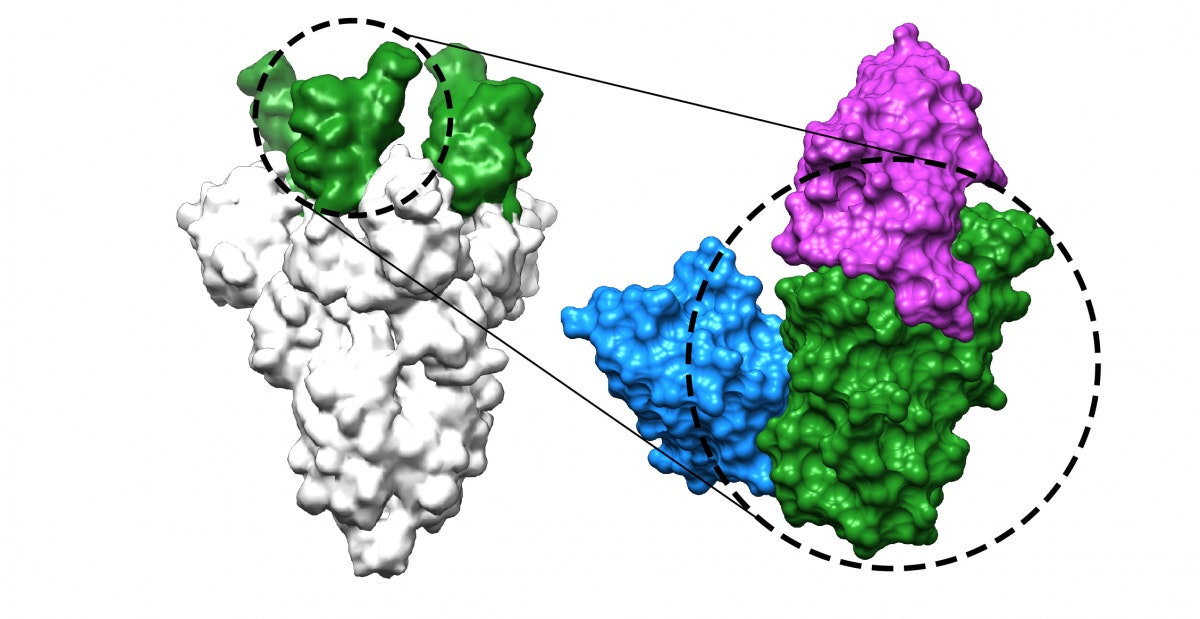
The nanobodies against Covid-19 (right) attach to the structures with which the virus recognizes its host cell. That prevents the infection. (Graphic: MPI for Biophysical Chemistry, Göttingen)
Mode of action: Block spike protein
First of all, the new mini-antibodies do not differ from similar products from other laboratories. What they all have in common is that they attach themselves to the spike protein that enables the virus to recognize its host cell. By doing this, they prevent it from infecting cells. The fact that the alpaca nanobodies can withstand particularly high temperatures has two advantages. For one thing, they stay active in the body long enough to be effective. In addition, they are particularly easy to manufacture, process and store, confirms Matthias Dobbelstein, Director of the Institute for Molecular Oncology at the UMG.
Small antibodies with big advantages
“Our simple nanobodies may be suitable for inhalation in order to contain the virus in the airways,” reports Dobbelstein proudly. Since they are very small, they can also easily penetrate the tissue and contain the infestation directly at the site of infection. The smaller size of the nanobodies compared to conventional antibodies is due to the alpacas. The researchers injected part of the spike protein several times into the animals in the institute’s own herd and they then produced antibodies. The specialists took these from the camels and multiplied them in the laboratory. The exposure of the animals was therefore very low – comparable to a blood test in humans.
pack of three is broken down more slowly
To prevent the kidneys from excreting the little helpers too quickly, the researchers have linked three identical nanobodies inside. This increases the time it remains in the body and thus its effectiveness. Ideally, this also improves the binding efficiency, as one of the bodies adheres to one of the three binding domains.
Clinical studies at a glance
After the biochemists extracted the blueprints for around a billion nanobodies from the alpaca blood, they fished out the best with the help of bacteriophages . They tested these using virus infections in cell cultures. Now that they have found the perfect blueprint, they want to test the nanobodies as quickly as possible for safe use as an active ingredient. Dobbelstein says: “So that they can benefit those who are seriously ill and those who have not been vaccinated or who are unable to develop an effective vaccine.” The biochemists also see themselves as prepared for future variants. Despite the vaccination, the alpacas’ immune system continued to produce antibodies that were effective against the alpha, beta, gamma, and delta variants of the virus. “If our nanobodies prove to be ineffective in a future variant, we can immunize the alpacas again. Since they have already been vaccinated against the virus, they would adapt their antibodies to the new variants very quickly, “says Thomas Güttler, a scientist in Görlich’s team.

