





Five students in the Department of Engineering at the University of Lancaster have developed an effective way to protect the health of employees in plastics and metals companies by limiting their exposure to nylon powder used for selective laser sintering.
Additive manufacturing and industrial 3D printing processes are in their heyday, changing the everyday lives of manufacturing companies and creating new manufacturing solutions. Rapid changes in manufacturing mean that work environments also need to be modified in the short term, and businesses need to ensure that the contact environment for new technologies, such as selective laser sintering, is safe and remains so in the long term .
Nylon dust that occurs and rotates during the removal of a 3D printed workpiece can be detrimental to the health of the employee performing this task, so if an intelligent system, ie a robot, takes over this task, a healthier, safer and cleaner work environment can be created. . Exposure to nylon powder is harmful because workers can inhale, swallow, or accidentally rub it into their eyes during their work. The Lancaster University student solution reduces employee exposure and thus eliminates the resulting health risks.
The University of Lancaster’s team of five engineering students has set themselves the goal of creating an intelligent system that is able to extract the workpiece produced during additive production from the nylon powder deposited as a result of selective laser sintering, so that no human worker has to come into contact with the material.
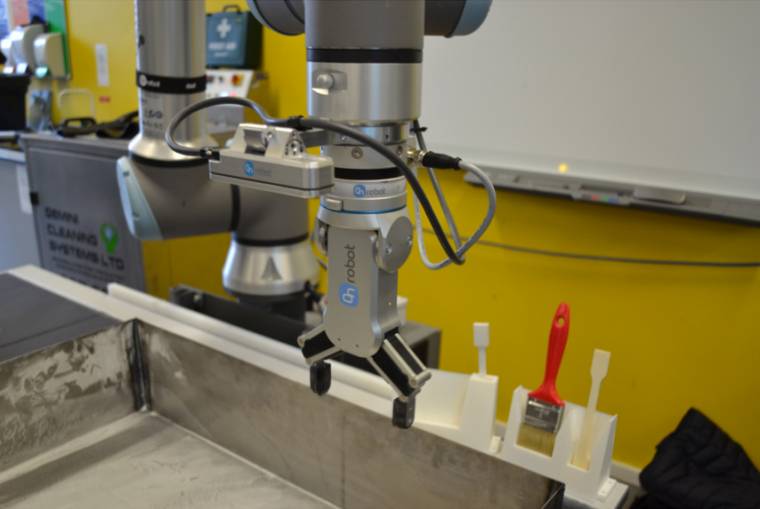
The team used various technologies in a complex combination during the project, including cooperating robotic arms with grippers, force sensors and image recognition systems. The workpiece is picked up by an RG2 grip, which is also used as a “probe” to pass through the dust, as it is rated IP54, ie it is protected against dust. The function of the HEX force / torque sensor and the HEX UR socket is to detect the level of resistance when the probe comes into contact with the workpiece. Finally, OnRobotEyes completes the application by recognizing the size and shape of the object. These tools have been added to a UniversalRobots UR5 kobo.
Student team leader James McEwan hopes the solution will help create safer jobs in the in the future:
“The system developed has proven to be robust enough to withstand different amounts of dust and workpieces of different shapes and sizes. As far as the impact of the system is concerned, this means that workplaces can become safer, as workers are no longer at risk of swallowing or rubbing dust in their eyes, which could have a detrimental effect. “
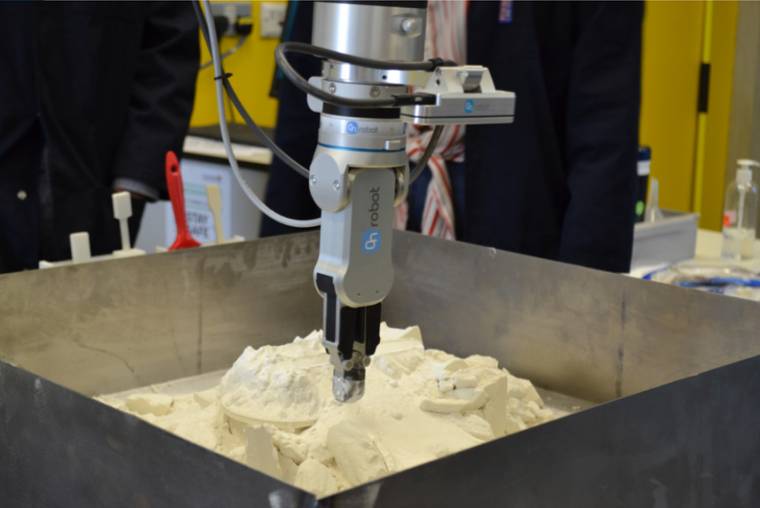
Lancaster students have provided an extremely solid foundation for further work on automated post-processing of products from addictive manufacturing. The team expects this to be just the first in a series of successful projects to improve the efficiency, repeatability and safety of manufacturing processes with kobots. Members also thanked the LancashireEnterprirePartnership program for supporting them in their development.
Professor Andrew Kennedy, Head of the Department of Advanced Manufacturing at the University of Lancaster, was impressed by the range of products and quality as well as the service and advice provided by Olympus Technologies, a local partner of OnRobot:
“We turned to Olympus Technologies to help us choose robots, end-effectors and image recognition products for our engineering laboratories. We had an idea about our first project, but we wanted a range of products that would provide the widest possible range for future applications.Although they were unable to see the site in person due to the pandemic, Olympus experts provided us with continuous remote assistance.Most of the equipment was extremely easy to install and and when our question arose, Oly mpus was able to provide a quick response. “
Adam Swallow, Director of Olympus Technologies Ltd., said:
“As an employer of graduate engineers, Olympus Technologies is pleased to see robotics integrated into the mechatronics and mechanical engineering disciplines and to encourage students to solve real problems with innovative robotics. As a result of Lancaster University’s decision to purchase UniversalRobots robots and various OnRobot accessories, the institution can provide groups of students and researchers with the opportunity to address a wide range of automation challenges. It was a pleasure to support this first team of students who completed a fantastic project despite how many challenges we face right now. We look forward to working with the university. “
VikramKumar, General Manager of OnRobotg, expressed his appreciation from the company’s Danish headquarters:
“The Lancaster University project is a great example of what we can achieve by combining human creativity with the flexibility and user-friendliness of our technology. All my appreciation to the young heroes of innovation! Automation is the way to the future, to ensure both the right work environment and strong competitiveness. I find this British project very interesting. “
Hardware, software, tests, curiosities and colorful news from the IT world by clicking here!

