






Podcast Seeding: We have put together 20 tips, some of which are likely to surprise you. (Photo: Shutterstock)
Before you get there though If you think about marketing, you should first build a significant reach. And for this you have to pull out all the stops of online marketing, because the market is rushed. We have put together 20 tips, some of which are likely to surprise you.
- 1. Email Marketing
- 2. Analog advertising media
- 3. The speaking title
- 4. The cover
- 5. The teaser and the trailer
- 6. The transcription
- 8th. The change interview
- 9. No podcast without Youtube
- 10. Social media seeding
- 12th player in your own website
- 13. Google Ads
- 14. Social media advertising
- 15. Podcast advertising
- 16. Linkedin groups and thought leadership
- 17. Conferences and webinars
- 18.Linking in older blog articles
- 19. Topic portals and websites
- 20. The podcast as an FAQ replacement
7. The press release
11. Reply to comments
1. Email Marketing
That you can hear the good news about the new podcast in your email Sending mailing lists or setting up a new mailing list to report on new episodes goes without saying. But what about all other mail recipients? The link to the podcast belongs in every email signature, just like the links to social media accounts.
2. Analog advertising media
The idea can be extended to all other forms of communication: business cards, folders, trade fair banners and of course ads. Combines the short teaser with a QR code so that you can scan it with your smartphone and thus have easy access to the podcast.
3. The speaking title
The denser the podcast landscape, the more important the podcast search engines become Platforms and, of course, Google itself. A poetic title like “Hobbyless” only works if there is a prominent personality behind it, in this case Rezo. Those who are less prominent should at least explain in the subtitle what it is really about. “Hobbyless, the relaxation podcast for workaholics”. Incidentally, only the title is displayed in Google search. Only a few words appear from the teaser.
4. The cover
The less text is visible in the searches and overviews, the more important is the visual stimulus. If the topic has a clear symbol (fire brigade=ladder truck), then it must be used. The heads of the moderators only come into play if you know them. And the cover should vary only a little over the individual episodes so that you can recognize it quickly. A good example is “Wissen Weekly” with two red brains stylized as cherries. By the way: Most top podcasts do not include a reference to the current episode in the cover.

In the search of Spotify has the cover is more relevant than the title. (Screenshot: Spotify)
The most important question that needs to be answered from the user’s point of view , reads: What’s in it for me? What do I get from that? Which question is answered? Which problem should be solved? Or what is the entertainment value? Again, be specific and precise. There is enough room for creativity once the users have started the podcast.
6th The transcription
No podcast without transcription. When search becomes more important, so do keywords. The transcript becomes a blog article, excerpts from it, such as pithy quotes, land on Twitter, Facebook or as text boards on Instagram. Bonus tip: If you had an exciting conversation partner, the text interview offers traditional media as a so-called guest article. You don’t usually get a fee for this, but you get the backlink in the podcast.
As far as automatic transcription is concerned, you could use services like Audiotyped work or use the Google transcription from Youtube. However, most of the solutions have problems when “Denglish” is spoken or many technical terms are used.
7. The press release
What an old school medium. But it is easy to forget the enormous reach many print and online media have. Most newsrooms only get PMs when a new podcast is launched. You could also refer to the new content on a weekly basis. Note: Journalists are also influencers.
8th. The change interview
An invitation to an interview is always flattering, even the smallest school newspaper can do that. Use the effect and invite an interesting podcaster from your network. Offers to conduct a double interview that both can use as an episode. This is not only efficient, but also increases the range of both podcasters. The double interview can be recorded one after the other in the classic way or you really do it in an open conversation in which both question each other.

Olli Schulz, the congenial partner of Jan Böhmermann at Fest & Flauschig, was interviewed by Eva Schulz for the podcast Deutschland3000 and the interview was rendered with a still image to the video and on Youtube placed. (Image: Deutschland3000)
9. No podcast without Youtube
The storytelling experts Bernhard Kalhammer and Uwe von Grafenstein found out rather surprisingly that the podcast is a good promotional format for their books and workshops. The focus was actually on the YouTube channel, but the two Munich-based companies decided early on to do an integrated production. They developed different formats that work as both video and podcast. This keeps the workload within limits. Youtube also enables the publication of behind-the-scenes films, takeouts or additional material.
By the way: hosters like Libsyn do from the finished podcast a video with mood pictures.

Bernhard Kalhammer (left) and Uwe von Grafenstein (right) produce the YouTube videos so that they also work as a podcast episode. (Screenshot: Stories That Sell)
10. Social media seeding
This supplementary Material also migrates into the other channels. An Instagram story can be cut from a longer YouTube video. The choice of format is important here. While many YouTube videos are published in a horizontal format, Insta, Facebook and Co are of course in portrait formats. The usual compromise is: square.
And don’t forget: topic hashtags are an essential part of publication. And you can, for example, search for groups on Facebook that deal with the topic and become active there with posts and comments.
Also the shoutout is a popular technique. If you deal with a brand or an important protagonist of your own industry in terms of content, it will be postponed in the social media post (@LieschenMueller). This means that the celebrity learns about the mention and may share such a post in their own network.
11. Reply to comments
Comments are not only nice to have, they also influence the ranking. For a platform like Spotify, a comment is always a signal of relevance. If you enter into a dialogue with the users, your chances of more visibility in the organic lists increase, for example in the case of topic clusters.
12. Player in your own website
A sure-fire success , but many still forget that: Podcasts can also be listened to on the desktop PC or notebook. Users who happen to discover the offer on a website or blog may just want to listen briefly before deciding to consume an entire episode. So it includes a web player that works in the browser. Ideally, it should be integrated into an overlay so that it is displayed as an element on every page. Corresponding plugins are available for the large CMS. The plugin Content-After-Post can do this for example with WordPress.
13. Google Ads
The good old search engine marketing. In fact, Google Trends shows that the search term “podcast” is searched up to a million times in German-speaking countries every month. And the interest is consistently high. Of course, Google Ads can quickly turn into money if you are not careful m it bypasses the keywords. In addition to the “inclusion” keywords, which should definitely be included in the search query, you should also devote yourself to the exclusion of terms that do not match at all. And texts the search advertisement clearly and unambiguously. Why is? Who is the podcast for? And especially for whom not. If, for example, a regional topic is involved, interested parties from other regions may not play a role in target group planning. In any case, it is important to avoid unnecessary clicks.
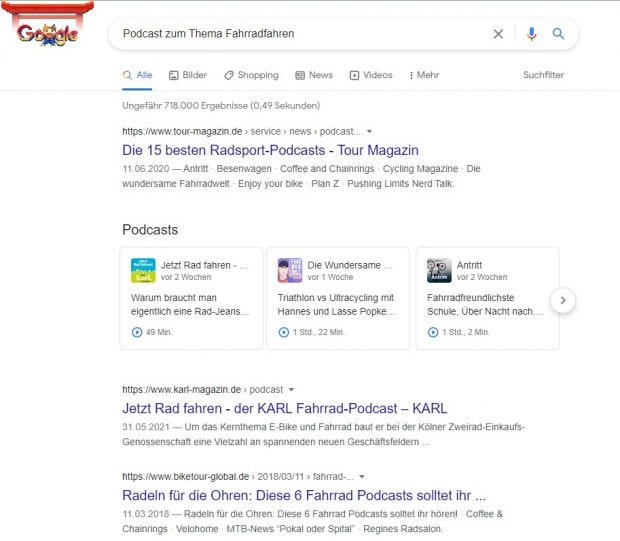
The screenshot from the Google search shows how important it is to be mentioned in third party articles (search result 1) and how little space Google allows for cover, title and description. (Screenshot: Google)
14. Social media advertising
The posting in your own social media channels mainly reaches people who already know you. And of that, usually between 15 and 20 percent. So it makes a lot of sense to refer to each podcast episode several times. Then with different aspects or sub-topics. Before the episode you can start a kind of countdown in which you can already publish brief insights or audio samples from the upcoming episode.
To new customers To win, you can use social media advertising very well, because targeting works so well, especially on Facebook and Instagram. Here you can select very precise criteria that fit the target group. From gender to place of residence to specific interests. Unlike Google, Facebook also knows a lot more about users’ private interests. Which films did you watch, which brands did you like?
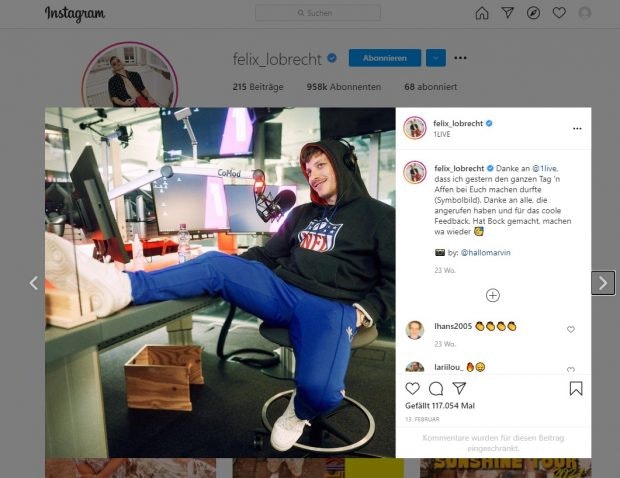
Felix Lobrecht shows classic behind-the-scenes pictures on Instagram, of course especially for the real fans are exciting. (Screenshot: Instagram)
15. Podcast advertising
A currently underestimated one The tactic is to promote your own in other podcasts. In individual cases, this can even work as a counter-deal, similar to a link exchange in the past. You look for a suitable but perhaps complementary podcast, develop a short audio teaser and both podcasters incorporate the cross-reference.
But now such slots can of course also be booked. What is exciting is that such a campaign will definitely reach podcast listeners. So there is no inhibition threshold for the medium. Tip: Ask your target group which podcasts they are listening to, and then simply write to the respective hosts.
16. Linkedin groups and thought leadership
The podcast is not an isolated measure; in most cases it is part of an overall project. The respective sender “stands” for a topic and he can do that excellently on many channels outside his own jurisdiction. Linkedin stands here for the business community. Topics are discussed in groups and those who have a say have the opportunity to advertise their podcast. The same applies to all other forum systems. Anyone who understands cars can, for example, participate in discussions on Motortalk.de.
In fact, the broad presence on a topic also has a positive effect the search engine ranking of your own website. The Google term for this is called Authority. Linkedin calls this thought leadership.
17. Conferences and webinars
If you’re already on poaching in unfamiliar terrain, then the view is welcome to widen. Are there conferences on your topic, who is hosting a webinar? In the webinar, even participating as a listener can be helpful, for example when asking questions. In addition, you can strategically make a podcast episode about an upcoming event and then take content from the event with you. In both cases, it is worth contacting the organizer, including when it comes to promotion. For example, he could send the link to the finished episode with the review to the participants.
This works similarly but more spontaneously with clubhouse talks or Conversations in Twitter Spaces. As a questioner, you are often called onto the stage virtually. Over time you develop an expert status and you may then become an interview partner or panelist yourself.
18. Link in older blog articles
Podcasts is inherent in the fact that they work as a news but also as an evergreen format at the same time. Since the users listen to them when they want, older episodes also play a role in the current findability and thus in the growth of the channel.
But there was a life before the podcast. Which older blog articles fit the topic in such a way that a dedicated link to a podcast episode makes sense? Tip: Take a look at the website statistics and start with the most successful pages.
And another tip: If you even watch the podcast for If it is part of the main navigation, you can take it with you in the sitemap and pass it directly to Google. Then it appears very prominently in the search, at least when your brand is searched for.
The integration of the podcast into the blog is a matter of course, but the full potential is only realized when the links are made within individual posts. (Screenshot: Of wheels)
19. Topic portals and websites
It is tactically safe right to first look at the large podcast portals of Spotify, Podcast.de, Podimo, iTunes or Soundcloud and show yourself there. This is often done through automated tools or hosters such as Libsyn and Podigee. However, it is worthwhile to give the approach a little more space. What about portals that weren’t made specifically for podcasts, but where your topics play a role? That goes from the big magazine editorial to the small private blog. Sometimes you have to create a specialist article (see above) from a podcast episode in order to play a role there. Sometimes the operators of such sites are just happy about the information. And again: Invite the operator of such sites to an interview! That opens doors.
20. The podcast as an FAQ replacement
The The fact that previous podcast episodes are still relevant today opens up a whole new area of application. You can also produce podcast episodes just to explain topics. You are then not bound to regular publication and constantly new content. But they can be used wonderfully to explain basic facts that may be the subject of customer questions over and over again. And then you can send them a link in the e-mail to the further content in the podcast.
Which brings us back to the e-mail -Marketing would have arrived …

