






(Photo: Shutterstock)
Whether you like WordPress or not: With a market share of over 60 percent, the online world can no longer be imagined without the content management system. And it is unlikely that much will change in the future. However, the way WordPress websites perform in the future could change dramatically.
Why classic editorial systems will soon be obsolete
Websites are just one medium among many. They have become increasingly complex, which is why the demands on modern content management systems are also increasing. Different apps for a wide range of devices have also been added. It is advantageous if you can use an editorial system to maintain your content, which then outputs it to different channels.
Who to For example, if you write a news post and want to publish it on your website as well as in an app, you save a lot of time if changes are only made once and then adopted on all other portals.
With WordPress, such a concept could already be implemented. But even if you don’t want to use apps, such a solution could offer attractive advantages. Before that, the concept should be examined more closely.

WordPress as headless CMS: One database for many channels. (Graphic: Timo Höhn)
More on the subject
- WordPress 5.8 is here: It continues towards full-site editing
What is a headless CMS?
The main advantage of an editorial system like WordPress is that users without HT ML skills can create texts and edit content. A graphical user interface is available for this purpose. These texts and images are stored in a MySQL database and then visually represented using the programming language.
That is, WordPress consists of these three Components:
- One database for all texts and images,
- a graphical user interface for editors and copywriters as well as
- PHP templates that create pages from the content stored in the database, which can then be viewed in the classic way via the browser.
A “headless” CMS only uses the first two components and hands over the visual implementation or rendering to one their technology. For the editors, everything would stay the same. Only the browser would have to proceed completely differently in the background to make everything visible.
Web technologies in transition
Especially the combination of PHP and MySQL has turned out to be very robust and reliable. But modern web development embraces a completely different trend: JavaScript. The frameworks from Google and Facebook, which have created new possibilities for the development of websites and web apps with React and Angular, also rely on this. This includes, in particular, the single-page apps. With such applications, the browser no longer has to reload when switching to a new page.
But what happens to the widespread combination of PHP and MySQL when JavaScript websites should prevail? Since WordPress does not want to lose its supremacy, there is already a practical basis for this. As a headless CMS, the editorial system could continue to be used in the background, while a JavaScript-supported framework is responsible for the presentation, for example.
The WordPress REST API
With the versatile interface, information from posts, pages and media from WordPress Database can be queried. For this purpose, the domain only needs to be supplemented with appropriate parameters and requested. Via https://deineseite.de/wp-json/wp/v2/posts you can, for example, view all your blog posts.
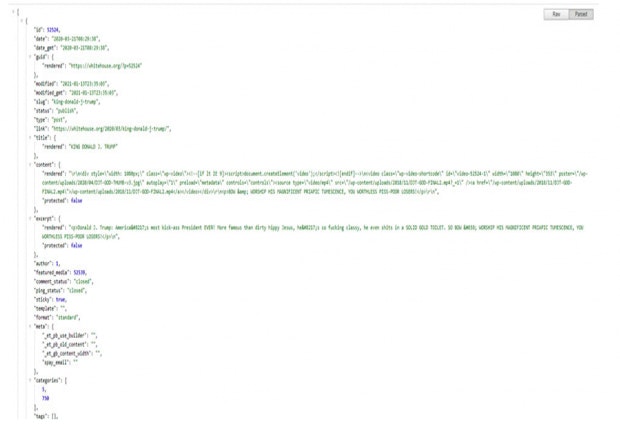
(Screenshot: Timo Höhn)
This is how the blog articles look in JSON format. Posts stands for the postings (contributions). But there are many other parameters with which content can be queried. WordPress also offers the option of displaying individual results (endpoints), for example for specially created post types.
Bare data
In our example, all blog posts with the associated metadata are output in JSON format. The raw information is structured in such a way that, for example, it is transformed into classic HTML with a JavaScript framework and designed with CSS.
The The front end (i.e. the front visible part of the website) is then clearly separated from the back end (the user interface for WordPress editors).
Advantages of a headless CMS
What are the advantages of such a solution?
- Speed (especially on mobile devices)
- Play from one source on several channels
- Better protection of the editorial system against hacking attacks
Disadvantages of a headless CMS
- The content can no longer be easily tested and adapted using a preview function.
- The creation of a sensible layout is hardly possible without programming knowledge.
- The development of such a website is more complex and therefore usually more expensive.
If “headless” solutions should actually prevail, it will take a while until then. If you don’t have to play several channels at the same time, you don’t have enough reasons to switch.
Finally, the question arises, why you should rely on WordPress for such a solution. With its REST API, the system offers a convenient solution that you can fall back on without having to develop something comparable yourself. It also offers a lot of leeway for individual adjustments. However, you should check in advance whether it really meets your own requirements. The biggest advantage, however, is certainly that editors do not have to think their way into a new system and can enter website texts as usual.

Timo Höhn

