






- How do smart contracts work in Ethereum?
- Why don’t you use an existing language and runtime environment?
- Web assembly, a universal intermediate language
- Ethereum flavored web assembly
- Smart Contracts in Webassembly
- Solidity
- Deployment and other options
- Conclusion
In order to understand the principle of smart contracts in Ethereum, it is first necessary to undertake a brief excursus into the world of programming languages. The common programming languages are basically divided into two groups: interpreted and compiled languages. In the first group, programs are written in a high-level language, which are then executed by an interpreter. Two popular examples of this are Python and JavaScript. Interpreted languages are common in many application domains (such as the web) because you can get started right away. In addition, they are very universal and can be used on different platforms without the need for additional tooling.
On the other hand, there are compiled languages in which a compiler initially writes the program text transferred into another language – often binary machine code. This binary code is platform-dependent and is executed directly on a processor. The compiler can (and must) output tailor-made code for the instruction set of the processor, for example for ARM or Intel compatible CPUs. Well-known representatives of this type are C and Rust.
However, as always, reality is more complex than these simple categories suggest. There have been mixed forms for a long time, such as Java. The Java compiler does not translate Java code directly into “real” machine code, but into a special intermediate format. This intermediate format, in turn, is then executed by an interpreter – the Java Virtual Machine – on the specific processor architecture.
(Illustration: Lars Hupel)
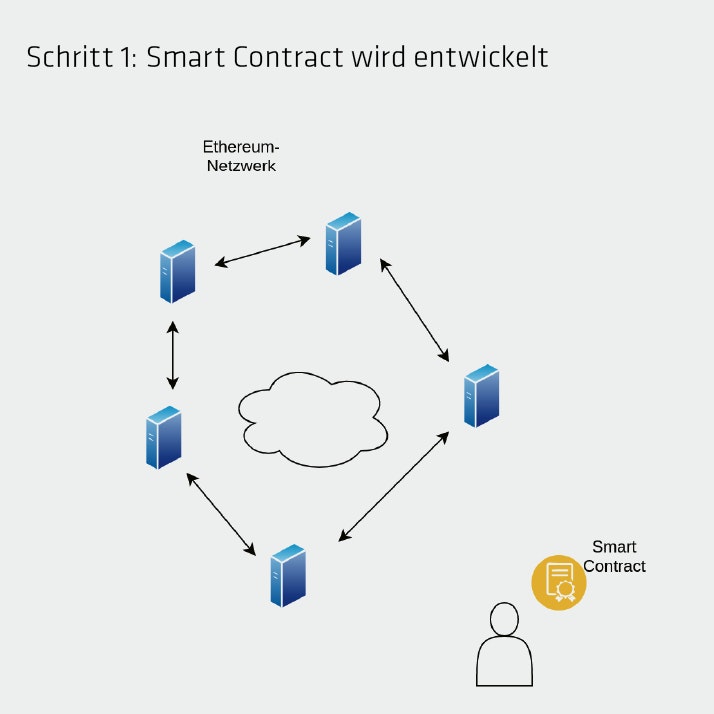
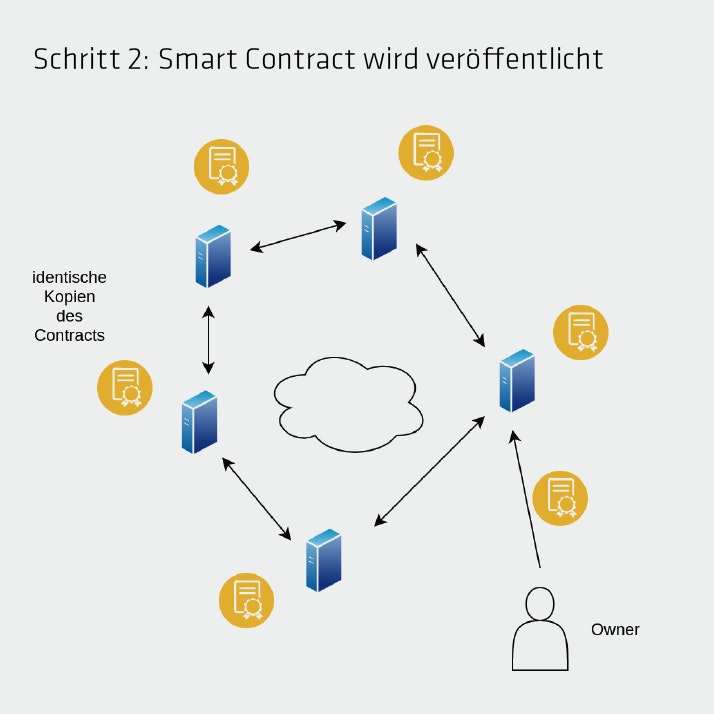
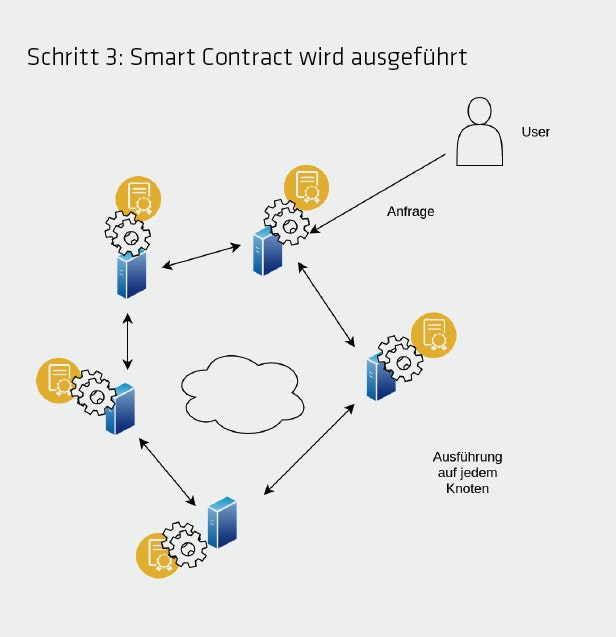
The smart contracts in Ethereum work in a similar way. All nodes that validate transactions in Ethereum and mine new currencies contain an instance of the Ethereum Virtual Machine (EVM). In the Yellow Paper, the technical specification of Ethereum, it is precisely defined which instructions the EVM support – and how they are to be executed.
It is an in-house development that numerous Features:
- Interaction with the outside world is not possible: All algorithmic decisions must be taken from the blockchain and their transactions.
- Arithmetic is based on 256-bit values to make it easier to deal with addresses and larger amounts of money.
- Special operations like the Hash functions are built in directly to increase performance.
- All instructions are a cost function (fuel) assigned, which roughly corresponds to the required execution time and the memory requirement. In English the term metering is common.
- Programming on the EVM
Similar to the Java ecosystem, there are several programming languages for which EVM compilers are available. The most common language is Solidity, which superficially (syntactically) is reminiscent of JavaScript. As of the end of 2020, the Ethereum documentation lists two other languages: Vyper, which is based on Python, and Yul Plus, a completely independent development.
Also interesting: “Ethereum founder Vitalik Buterin : Philosopher in a rainbow shirt “
What all these languages have in common is that they are domain-specific, because in contrast to general-purpose languages, they occupy a niche with special features and in particular a special runtime: the EVM. Of course, such domain-specific languages (DSL) are generally a good idea to reduce the complexity of applications.
But in the case of the EVM, that doesn’t make much sense. After all, it can – regardless of the lack of interaction with the blockchain-external world – execute any algorithms, so (to put it simply) it is Turing-complete.
Why not use an existing language and runtime environment?
If necessary, you would then have to remove features, but you could benefit from a longer experience, more stable tooling and – much more importantly – a broader base of programs fall back. Because it is old hat that nowadays the popularity of a programming language not only depends on whether you can program in it particularly concise, type-safe or dynamic, but also how easily you can access how many existing libraries and packages. This change of times is particularly illustrated by JavaScript, which is often criticized for its crude semantics, but has been the most popular programming language since the millionth NPM package at the latest.
Web assembly, a universal intermediate language
The human behind the Ethereum specification have come to the conclusion that some problems arise from a migration away from an in-house development to a universal language hey let loose. How practical that development is currently underway on the web to establish an alternative to the top dog JavaScript: web assembly (WASM). This is both a universal intermediate language and a binary format, paired with a specification for interpreters. As the name suggests, the open standard was originally conceived for the web; Meanwhile, however, other areas of application (e.g. smartphone apps) are also being discussed.
The development of WASM is being driven by industry giants such as Microsoft, Google and Apple. What distinguishes the language is that it is designed for portability from the start. This can be recognized by the fact that numerous existing programming languages such as Rust, C ++ or Go can already compile for web assembly.
(Illustration : Lars Hupel)
So also a perfect basis for smart contracts? In fact, Webassembly seems to be made for this purpose. Even in the browser – the original domain for WASM – it is necessary to strictly regulate the running code in order to prevent security gaps. Furthermore, the fact that WASM does not have garbage collection, so you as a programmer yourself t has to take care of memory management for the deterministic execution of algorithms. As a bonus there are solid and efficient interpreters available for different platforms.
Ethereum flavored web assembly
All of these are also criteria that are extremely important for the design of a blockchain. Therefore, the use of Ethereum flavored web assembly (EWASM) is the logical aim of the long-term planning of Ethereum 2. EWASM is fully compatible with WASM, but introduces an additional interface to the blockchain in order to be able to control typical Ethereum operations (for example the transfer of tokens). For Ethereum users, the interaction with EWASM smart contracts is transparent and works exactly like EVM contracts.
Smart contracts in web assembly
But how do you proceed if do you want to program a smart contract in EWASM? On the one hand, you need a suitable Ethereum network. Because as beautiful as the vision of Ethereum 2.0 is, it is just a vision. Unfortunately, there is no official test network, but you can switch to Oasis Ethereum, which is compatible with Ethereum and in a sense offers a preview of the future Ethereum 2.0.
You also need a programming language to avoid having to write assembly code by hand. Rust offers many advantages here. Thanks to the support of WASM in the Rust compiler, compatible smart contracts can be generated directly from a Rust program. However, Rust is currently not a sensible choice for Ethereum because the toolchain is still too fragile. Most of the examples that can be found on the internet are already out of date shortly after publication.
Solidity
That is why it is worth taking a look at Solidity here instead. The classic example of a smart contract in Solidity is an ERC-20 token, a standardized interface to manage any token on the Ethereum chain. By default, Ethereum uses the currency ether. With ERC-20 tokens, you can define other currencies, for example a token that can be exchanged one-for-one for euros. Such a contract has a fixed structure. Basically there are storage fields in the contract for:
- Amount of tokens in circulation (an upper limit can therefore be set )
- Current account balances
In Solidity this can be defined as follows:
  uint256 private totalSupply;
 mapping (address=> uint256) private balances;
 Finally, there are methods to transfer tokens from one account to another.  To do this, you have to make sure that there is no underflow or overflow:
 function add (uint256 a, uint256 b) internal pure returns (uint256) {
 uint256 c=a + b;
 require (c>=a, "SafeMath: addition overflow");   return c;
}   function sub (uint256 a, uint256 b) internal pure returns (uint256) {
 require (b uint256 c=a - b;   return c;
}
These two methods are used for the secure addition or subtraction of two numbers. For example, if there are not enough tokens on the source account, the transaction is aborted with an error message (“Subtraction Overflow”). The actual transfer function can then be implemented quickly t:
  function transfer (
 address recipient ,
 uint256 amount
) {
 balances=sub (balances , amount);
 balances [recipient]=add (balances [recipient], amount);
}
First, the account balance at the sender is reduced, then increased at the recipient. A call to this method is always transactional: If either the recipient already has too many or the sender does not have enough tokens, neither of the two operations is carried out. The above solidity code can be translated to web assembly using the SOLL compiler.
(Illustration: Lars Hupel)
Deployment and other possibilities
You can use this finished WASM file as usual deploy at Ethereum with web3.js on a blockchain. If you want to use Oasis for this, you can configure an appropriate provider. You can either work in the browser or in Node.js.
To deploy the contract, you have to create a new transaction that has not given a recipient address. The HEX-coded string of the web assembly code is transferred as data:
  const receipt=await web3.eth.sendTransaction ({from: 0, data: "0061736d ...", gas: 10000000});
 console.log (receipt.contractAddress);
If everything went right, the last line displays the address of the newly created contract:
'0xad1c3896b09F86906030654F6e92D61bf0D24293'
In addition to being used in a blockchain, the WASM code generated by the compiler can theoretically also be executed unchanged in the browser, provided that the necessary Ethereum functions are provided. The web assembly tools also offer a number of other processing options, for example the binary code can be translated to C. So it would be quite possible to use the same code in smart contracts as well as in classic applications.
Conclusion
Various Ethereum clients already implement this alternative VM, but are partially not yet compatible with each other. It is a pity that the Rust toolchain has not yet been properly integrated into Ethereum. However, since the development of Ethereum 2.0 is constantly progressing and there is a high level of interest in web assembly, there will hopefully soon be a more robust tooling.
This article originally appeared in t3n 63 Here you can find the latest magazine issues and here our archive.
You might also be interested in

