





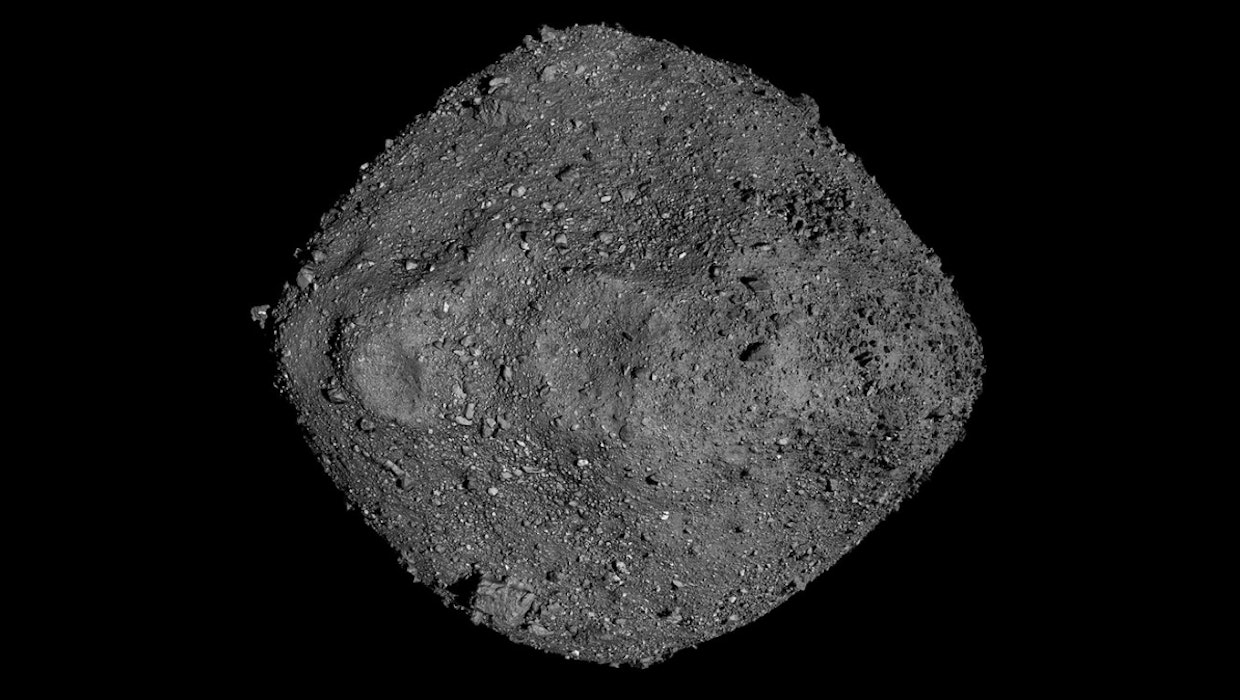
The asteroid Bennu. (Photo: Nasa)
September 24th, 2182, our descendants should better mark themselves in red on the calendar. On this day, according to the latest calculations, Bennu will collide with the earth. Bennu is the second most dangerous asteroid in the solar system. As Nasa announced, the probability of a clash is currently 1 in 2,700, which corresponds to about 0.037 percent. The chance of a collision by 2300 is 1 in 1,750.
The gyro-shaped and half a kilometer large Space rock is one of the two most dangerous known asteroids in our solar system. There is only 1950 DA ahead of him, which has a 0.3 percent chance of hitting Earth. However, not until March 16, 2880. By then it should have long been clear whether Bennu has found his way to earth or not. More is known about Bennu, however, since a space probe orbited the asteroid for years on the NASA Osiris-Rex mission. A sample was also taken from Bennus Regolith, the material that forms on crevices in the solar system through various processes. The mean diameter of the asteroid is about 492 meters.
More on the subject
- Nasa wants to develop new sources of income: Advertising in space
- 1 Year in the simulation: Nasa is looking for volunteers for Mars project
- Almost disaster on the ISS: Ex mission controller sounds the alarm
Many factors play a role
On the basis of these samples, which are expected to arrive on Earth on September 24, 2023, new data are to be determined, which should show Bennu’s path and thus also the chances of an entry into the earth more precisely. It should be possible to calculate Bennu’s trajectory very precisely by 2135. “We have never modeled the trajectory of an asteroid with this precision before,” said Davide Farnocchia of the Center for Bear-Earth Object Studies (CNEOS), operated by NASA’s Jet Propulsion Laboratory (JPL). He also added that “the impact velocity increased only slightly,” but that it would not be a significant change.
Um To be able to predict Bennu’s path through the solar system as accurately as possible, several factors must be taken into account. The team had to model the gravitational interactions between the asteroid and the sun and other planets, satellites, as well as more than 300 other space rocks and the pressure of the solar wind. Until 2182, however, several generations of scientists will have the opportunity to refine the calculations down to the smallest detail.

