





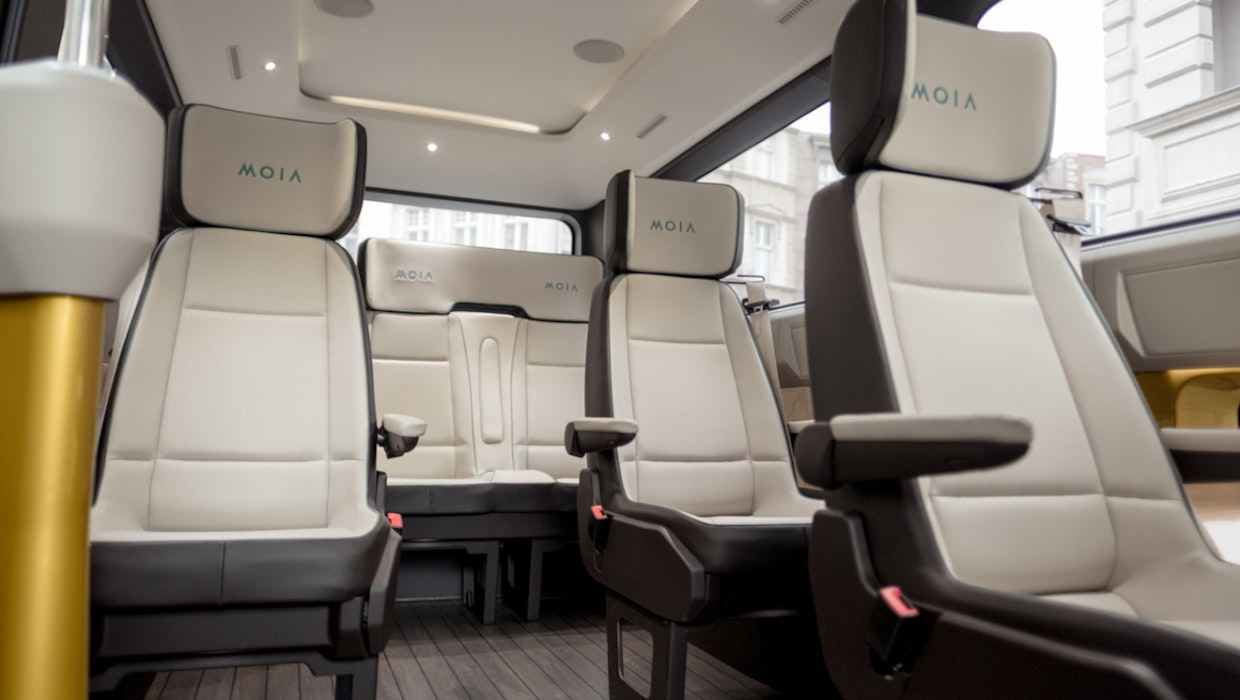
Ridepooling service Moia wants to revolutionize inner-city mobility. (Photo: Moia)
Driverless operation until 2025
The ID Buzz AD should be ready for the market and ready for completely driverless operation in 2025, as the head of autonomous driving at VWN, Christian Senger, said. “Until then, all vehicles will always have safety drivers on board.” VW had already announced at the IAA auto show in Munich that it would test self-driving Bullis in Munich and Hamburg. In the medium term, private customers and logisticians should also be able to use the technology.
In Hamburg, detailed maps of the test area would first be created, said Moia boss Robert Henrich around a month before the ITS World Congress on Mobility of the Future in the Hanseatic City. The first of ultimately up to 30 test vehicles should be on the streets in the coming year. The partners selected an approximately 50-kilometer-long route network in the districts of Winterhude, Uhlenhorst and Hohenfelde as a test area. “We want to go where it is difficult. (…) We want to go where there is dense inner-city traffic, “said Henrich.
More on the subject
- Last chance for MAN? Truck manufacturer will switch to electric drive from 2024
The system is far from mature
For Moia, testing is not all about the vehicle with its six lasers, eleven Radars and 14 cameras themselves, but also the services that drivers have so far taken over. After all, the system must also recognize whether the right people are sitting in the vehicle, whether everyone is buckled up and whether the luggage is secured. Or if a passenger suddenly changes his mind and wants to get out, the system must also be able to deal with it – not to mention a medical emergency while driving, said Henrich.
Tjarks said that the mobility transition in Hamburg not only requires the around 500 existing Moia vehicles. “We are talking about several thousand vehicles, with which we in turn want to replace tens of thousands of private cars.” That is not possible with conventional shared taxis. There aren’t that many drivers. In addition, it is not economically viable to do this with drivers, especially since the vehicles are also supposed to be on the road in sparsely populated areas such as the Vier- und Marschlande and by order. dpa

