






Mercedes EQE is optically based on the EQS

Mercedes EQE. (Photo: Daimler)
From the outside, the relationship with the EQS luxury sedan can be clearly recognized. The EQE has the same so-called “one-bow line”, in which the windshield, roof and rear window are stretched over the car like an arch. Furthermore, the two noble Stromers share the same EVA2 platform, which was specially designed for electric cars, while the other models such as the EQC and EQA are still based on combustion architectures.

1 of 9
Mercedes EQE should come up to 660 kilometers
At the market launch, the EQE will be available in two versions. However, Mercedes has so far only given information about one model. Like the EQS, the EQE 350 is driven by permanent-magnet synchronous machines (PSM) that deliver 215 kilowatts (288 hp). The EQE only has a rear axle drive, however, 4Matic variants are to follow.
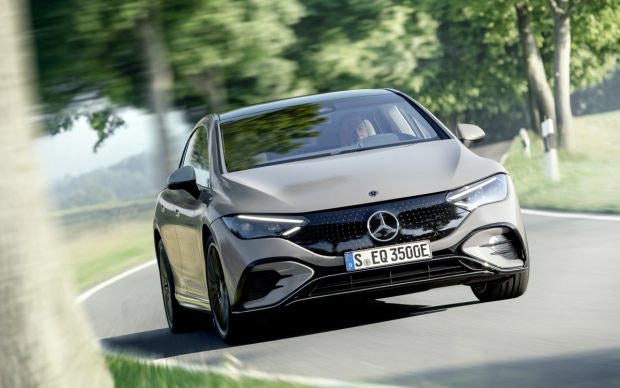
Mercedes EQE. (Photo: Daimler)
Furthermore, a 90 kilowatt-hour battery is installed. The range of the EQE should be up to 660 kilometers according to WLTP, depending on the equipment, with the lower WLTP range being 545 kilometers.
In terms of charging performance, the EQE does not quite come close to the EQS: While the top model can be charged with up to 200 kilowatts, the EQE ends with a maximum of 170 kilowatts. It should be possible to charge up to 35.5 kilowatt hours within 15 minutes, which according to WLTP would correspond to a range of up to 250 kilometers.
A three-phase onboard charger with eleven kW is installed ex works for AC charging . A full AC charge cycle is given as 8:15 hours. As an option, Mercedes wants to offer a 22 kW charger for the EQE. The battery should be fully charged within 4:15 hours.
For the battery, Mercedes makes a “performance promise to the customer” that is ten years or 250,000 kilometers with “a defined remaining capacity”.
Mercedes EQE with optional hyperscreen

1 of 3
When it comes to the interior, the EQE, like the EQS, should be able to be equipped with a so-called hyperscreen, which combines three screens under a 1.41-meter-wide cover glass. The surcharge for this extra is 8,568 euros for the EQS – it will be similar with the EQE. On the software side, Daimler’s MBUX system is of course on board, which can also be updated remotely. In this way, new functions can also be retrofitted.
In addition to the optional hyperscreen, the EQE also takes over the navigation with “Electric Intelligence” from the EQS. Based on numerous factors, you can plan the fastest and most comfortable route, including charging stops, and react dynamically to traffic jams or a changed driving style, according to the manufacturer. Among other things, a visualization in the MBUX infotainment system shows whether the available battery capacity is sufficient to be able to return to the starting point of the trip without charging.
The Mercedes EQE should – starting around mid-2022 – staggered the global market reach. According to Daimler, the EQE is produced in Bremen for the world market and in Beijing for the Chinese market. Daimler has not yet announced a price, but will not communicate it until the market launch, for example with the EQS.

