





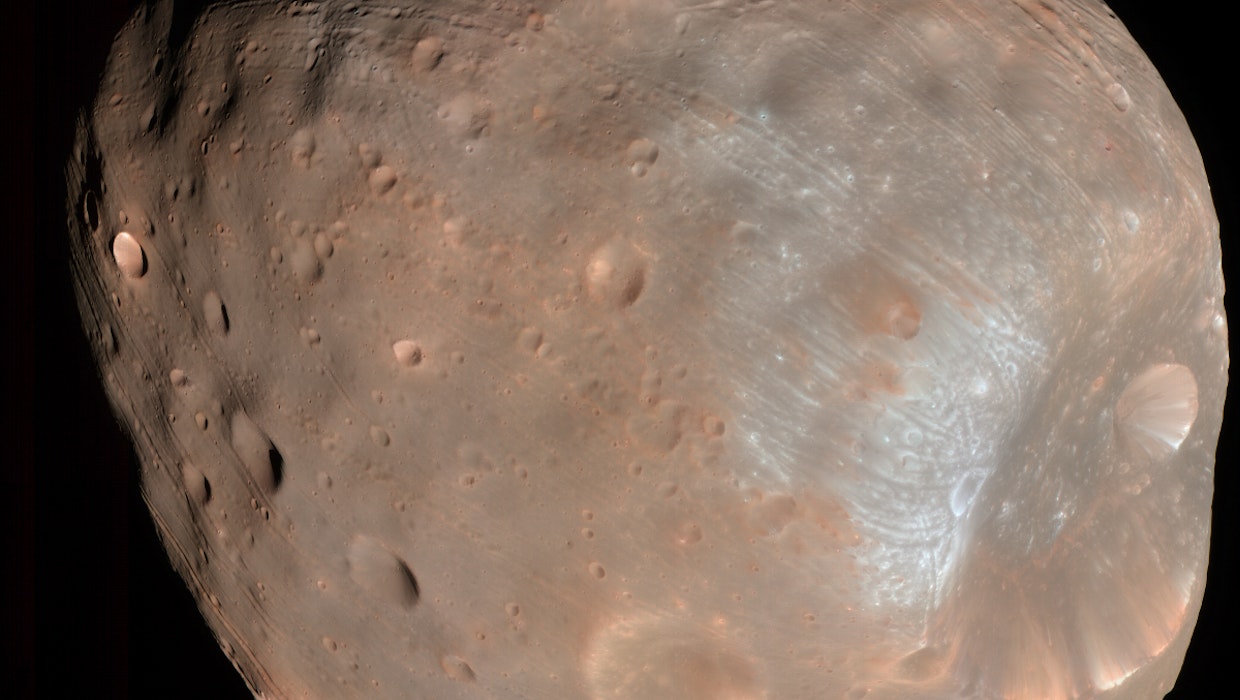
Mars rover Perseverance is recently on the first attempt to take rock samples from the red Removing planets failed. However, further drilling is planned. Together with Esa’s Earth Return Orbiter, NASA plans to bring samples back to Earth by the end of this decade and examine them for traces of past life. The Japanese space agency Jaxa plans to start a similar project soon, but on the Martian moon Phobos.
Japanese space probe flies towards Mars in 2024
A report by the Japanese Jaxa scientists Ryuki Hyodo and Tomohiro Usui published in the journal Science is said to be the – still under development – space probe Martian Moons Exploration are used. According to the plan, the spacecraft is set to leave for Mars in September 2024. Almost a year later, the landing on Phobos is planned. Martian Moon’s exploration is supposed to take a soil sample of ten to 100 grams there.
Subsequently, several fly-bys of the second Martian moon Deimos are planned. The samples should arrive on earth in 2029. There they will then be examined for possible traces of earlier life on Mars. In their article, the scientists also explain in detail why the Japanese space mission takes the samples directly from Phobos and not from Mars.
Looking for traces of microbiological life
In a nutshell: On the Martian moon, the scientists reckon with rock materials that are released into the Hurled into space and then landed on Phobos or Deimos. These could have traces of microbiological life that was previously possible on Mars.
Water or an atmosphere are not suspected on Phobos. Even if they did not find any traces of life, according to the researchers, the samples from Phobos and Mars could help decipher the question of why there is no (longer) life on Mars, but there is on Earth.

