





The retired aerospace engineer and book author James Oberg accepts what he believes is trivializing representation of the Nauka incident, neither on the part of the US nor on the part of the Russian space agency. Rather, the near disaster must be taken seriously as an “urgent wake-up call”. It shows that the security culture of NASA shows again “signs of decay”. An independent investigation is necessary.
The Nauka module, which cannot be switched off, suddenly goes crazy
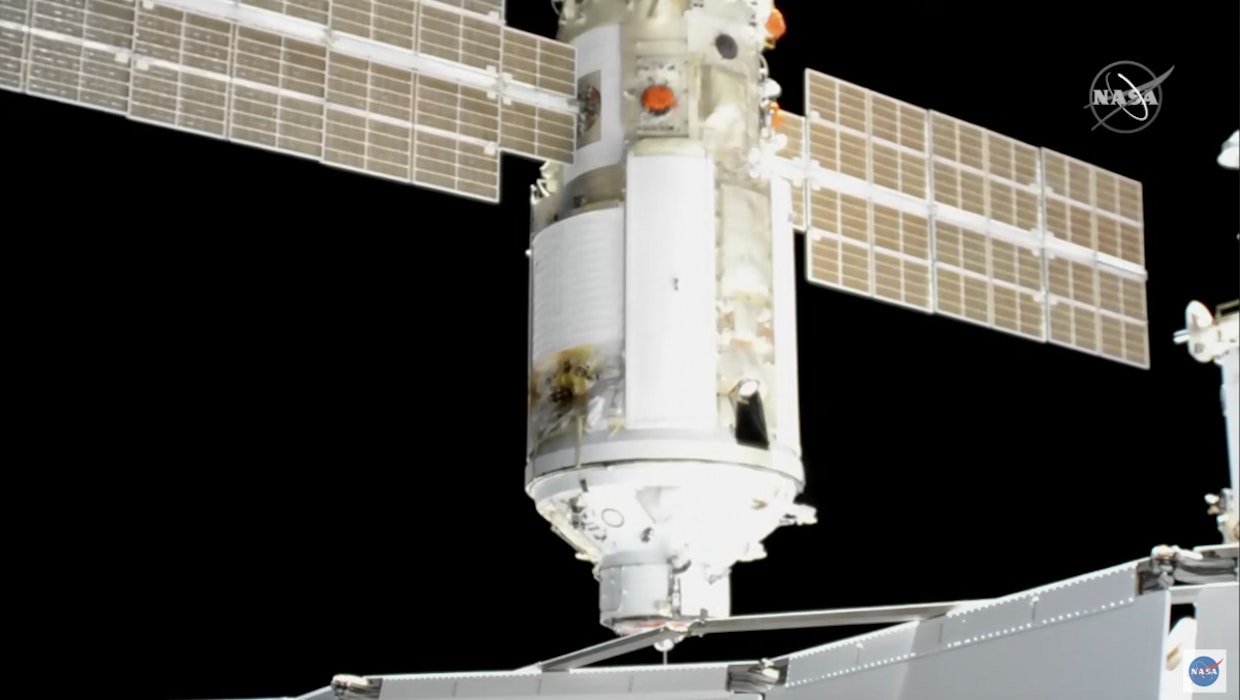
The incident, which Oberg dealt with in a guest article for the science magazine IEEE Spectrum, took place on 29 Occurs July 2021. Initially, a Russian laboratory module called Nauka had successfully docked with the ISS. While the cosmonauts were already working on the integration of the newly arrived module, its engines suddenly ignited and began to roll the ISS. This movement, which rotated the space station by 540 degrees, was not noticed on board the ISS.
A NASA air traffic controller noticed the changed position and used the ISS engines to counteract the movement. Nobody can say what would have happened if the engines of the Nauka module had not suddenly stopped. In any case, they could not have been stopped from the ISS.
Both NASA and its Russian counterpart Roskosmos had downplayed the incident, which was objectively the most serious incident on the ISS in its almost 25-year history, and insisted on it that astronauts should not have been endangered at any time. There will now be an investigation to determine whether the ISS itself has been damaged during the maneuver, the authorities said in unison. At the moment there is nothing to suggest.
Ex-Mission -Controller pissed off
“While the immediate cause of the incident has not yet been clarified, there are worrying indications that NASA is repeating some of the mistakes that led to the loss of the Challenger and Columbia space shuttles and their crews, “Oberg writes.” And since much of the problem appears to be due to political pressure, only an independent investigation of serious political weight can reverse an erosion of safety culture. “
For him it is “an open question” how close the station was to a catastrophe. He also does not want to accept the assumption that there will probably be no damage to the ISS. In his opinion, the stresses caused by the unexpected rotation could have damaged the modules, the girders, the solar panels, the coolers and the robotic arms.
Oberg sees a culture of complacency and political opportunism
For Oberg, the incident is an alarm signal that shows that NASA is too “complacent” and believes it could nothing happen, act. This culture of complacency already existed at NASA in the years before the Challenger disaster in 1986. At the time, Oberg was working in Mission Control.
At that time, team members would even have “noticed the growing negligence” themselves. Some have voiced their concern, others have joked that the occasional “stupid mistake” has not been followed. A similar “mental drift” occurred in the late 1990s during the joint American-Russian operations on the Mir and during the first ISS flights, recalls Oberg.
More on the subject
- Nasa blows test flight of the Boeing Starliner to the ISS again shortly before take-off
- Astronauts on the ISS compete at the Space Olympics
- Vacation on the ISS: Nasa offers 2 places for space tourists
This is James Oberg
James Oberg is a retired rocket scientist. Among other things, he worked as a mission controller at NASA from 1975 to 1997, where he was an expert in orbital docking maneuvers. He has incorporated his extensive knowledge of global space programs into the book “Star-Crossed Orbits”, which was published in 2002 and is primarily concerned with the development of the ISS. He also testified as an expert at various hearings before the US Congress.

