




“Experiments with Google” is Google’s platform for showcasing new technologies. Now the web standard WebXR, which makes augmented (extended) and virtual (virtual) realities accessible via the web, joins it.
The WebXR experiments are open. Google asks its users to submit further applications with access to the API.
In the meantime, the Developers from the Google Creative Lab contributed four apps, three of which are already available. To use it, interested parties need an Android smartphone with ARCore support and the current Chrome browser.
These are Google’s WebXR apps
The Google creatives really came up with something for the WebXR experiments. These are the apps:
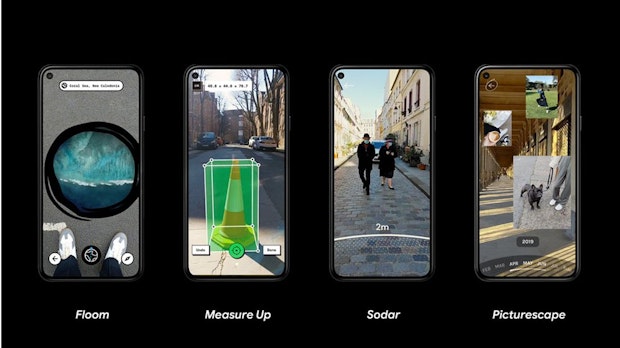
- Sodar specializes in visualizing social distance. Using augmented reality radar, you can project a two-meter distance onto any environment.
- With Measure Up you can calculate the length, area and volume of things in your environment without using a tape measure.
- Floom is the creative hit among apps. With this app you can tunnel your way through the earth anywhere and see what is exactly on the other side of the planet. In addition to WebXR, Google also uses Google Maps.
- Picturescape is still in progress. This is an alternative gallery that shows you your Google Photos library in a previously unknown way. The app should be available shortly.
This is WebXR
The WebXR device API provides access to the input and output functions of VR and AR devices. The API can be used to deliver AR / VR experiences over the web.
The WebXR device API emerged from the former WebVR, which only dealt with VR. With WebXR, however, AR applications, which are considered to be far more promising, can be created in which reality is expanded to include data views.
All of this works with smartphones that use the camera to integrate a view of the real world, as well as with corresponding data glasses, which basically offer the same functionality, but allow a more immersive experience by being seated in front of the eye .

